


English
- English

CONTACT US
If you have any queries, get in touch today! Don't hesitate. We try to take the extra step for our customer satisfaction.
Our News
Carbon Conversions offers recycling solutions to companies that need to dispose of excess carbon fiber from decommisioned parts.
The European project uses resin injection and thermoplastic composite materials technology to advance the OOA outboard wing fairing.
2025-08-27 18:13:23
Click:
“
The
European project uses resin injection and thermoplastic composite
materials
”

The European project uses resin injection and thermoplastic composite materials technology to advance the OOA outboard wing fairing.
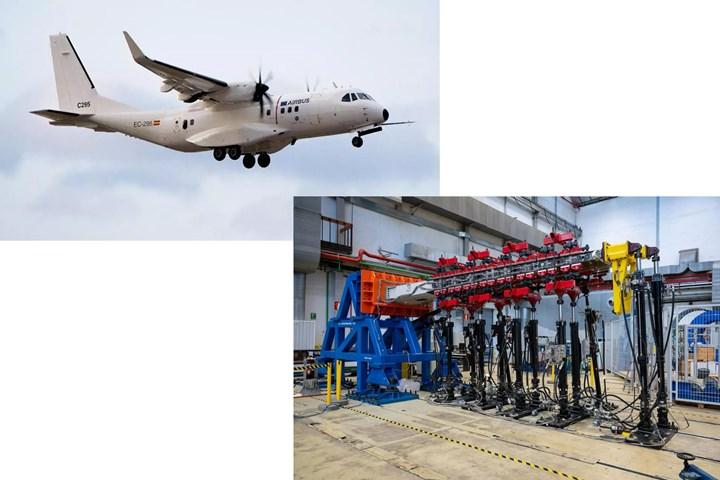
Airbus C295 Flight Test Bed 2 (FTB#2) successfully completed flight activities, testing a new semi-span wing and ground structural tests of a new composite wing box.
According to the Clean Sky Programme, the Flight Test Bed 2 (FTB#2) of the Green Regional Aircraft (GRA) project - an improved version of the Airbus C295 - has successfully completed its flight test activities.This aircraft marks an important milestone in the advancement of next-generation sustainable aviation technology. It integrates advanced aerodynamics, innovative flight control, and new composite material technologies to enhance efficiency and reduce emissions, including:
- A reduction of up to 43% in carbon dioxide and 70% in nitrogen oxide emissions in regional aircraft multi-mission scenarios, with a 45% reduction in takeoff noise.
- Successful testing of semi-morphing wings, dynamic winglets, and advanced flight control systems to optimize aerodynamic performance.
- Innovative manufacturing processes, including additive manufacturing and one-piece composite assembly, to improve production efficiency.
Against the backdrop of growing global pressure to curb the environmental impact of aviation, these combined achievements are timely. Stricter carbon emission regulations, coupled with increasing societal demand for sustainability, are driving the need for more environmentally friendly air travel. The successful flight of the FTB#2 demonstrator highlights Europe's leadership in sustainable aviation and underscores the importance of the Clean Sky 2 (now Clean Aviation) initiative in leading these crucial advancements.
By combining these design/manufacturing elements with other aerodynamic enhancements of the C295 flight demonstration aircraft, such as lightweight composites and more efficient propulsion systems, the flight test campaign was successful. Overall, these modifications optimized fuel consumption while maintaining the aircraft's reliability and multi-functionality. Data collected during the flight provided valuable insights into real-world performance, confirming the effectiveness of these innovations.
FTB#2 Multi-Mission Platform Testing
As explained by Clean Aviation project officer Costin Ciprian Miglan, the FTB#2 is a multi-mission platform that can support a variety of configurations for different roles. Miglan said, 'For example, it can be used to transport passengers, carry cargo or humanitarian aid, or the aircraft can be equipped with fire retardant substances and used to fight wildfires.' 。
The flight test campaign included 12 successful flights within 17 flight hours, with all planned test points fully achieved. The results were highly satisfactory, confirming the maturity of the key technologies tested on board. These included innovative composite external wing boxes and morphing control surfaces.
Enhanced use of composites
This flight campaign was complemented by ground demonstrations of out-of-autoclave (OOA) cured carbon fibre reinforced plastic (CFRP) external wing boxes based on a highly integrated design that minimised the use of two different materials and manufacturing processes. The first was liquid resin infusion (LRI) for the lower skin, integrating the wing spar, stringers and main structure into a single one-time infusion part. The second was in situ consolidation (ISC) using automated fibre placement (AFP) to produce a thermoplastic composite (TPC) upper wing panel with integrated stringers. This resulted in a total weight reduction of 5.6% compared to equivalent traditional components.
A highly integrated composite winglet based on a single multi-spar torsion box (saving 20% in weight compared to a traditional structure) was also subjected to a comprehensive structural test from detail to full-scale. This improved winglet also reduced costs due to a reduction in riveting during manufacturing.
Commenting on the step-by-step process of flight and ground tests, Miglan from Clean Aviation explained: 'The first step was flight testing; the second step involved further maturing other technologies, but only on the ground, such as the external wing box and the drive system for the movable surfaces. The flight test is an important milestone for Clean Sky 2. In this campaign, the entire external wing from engine to wingtip was completely replaced. This achievement is the result of multiple 'core partners' and 'request for proposals' projects under the fuselage and regional platform, all integrated by Airbus Defence and Space.'
For more details on FTB#1 and #2 and the flight and ground test plans, please refer to Clean Aviation Regional Aircraft.
Overcoming Challenges in Development
Developing the C295 demonstrator was no easy feat. The project faced several challenges that had to be addressed for success.
'Integrating multiple advanced systems into an existing aircraft while ensuring compliance with safety regulations requires a precise integration strategy,' emphasized Miglan. 'Engineering challenges related to new aerodynamic designs, composite materials, and propulsion technologies must be overcome through rigorous testing and iteration. Coordinating the efforts of various European partners, each contributing their expertise, demands strong coordination and communication. Meeting strict aviation certification standards is another key factor in ensuring the safety and feasibility of all new technologies for future applications.'
Despite these challenges, the project's success highlights the advantages of collaborative innovation in advancing sustainable aviation. Looking ahead, Airbus Defence and Space will continue to contribute to the next stage of clean aviation. The experience gained from the C295 demonstrator will inform future projects, ensuring the continuous progress of aviation sustainability. The project has generated valuable insights that may lead to further technological innovations and commercial applications.
environmental benefit
The FTB#2 demonstrator has set new standards for the operation of environmentally friendly regional aircraft. The combination of advanced materials, innovative technologies, and aerodynamic improvements aimed at reducing noise, carbon dioxide, and nitrogen oxide emissions exceeded initial expectations.
'In typical search and rescue missions, we estimate that these innovations can reduce carbon dioxide emissions by up to 43% and nitrogen oxide emissions by 70% in a typical 400 nautical mile search mission, while reducing noise by 45% at takeoff,' said Luis Benitez Montanes, the former project director of Clean Sky 2 at Airbus Defence and Space, who led the Airbus side of the FTB 2 project. 'These improvements not only support Airbus' sustainable development goals but also pave the way for more environmentally friendly air travel worldwide.'
The project, which lasted from 2014 to 2024, was developed, improved, and integrated by a consortium of 12 countries and over 60 research and academic institutions, industrial partners, and technology providers. Airbus Defence and Space (formerly EADS-CASA) led the integration and testing of new technologies. The total budget for the C295 demonstrator was 102.5 million euros, of which 55.4 million euros was specifically allocated to the Clean Sky 2 aircraft program, and 47.1 million euros was allocated to the Regional (REG) innovative fuselage technology demonstrator program (IATD). The EU contributed 27.7 million euros for the aircraft framework FTB#2, and an additional 23.55 million euros was allocated to REG IATD, totaling 51.25 million euros. Additional Explanation
For the specific details of the green wings, please refer to
the 'New Regional Aircraft - Thermoplastic Composite Deformable Wing' WeChat article on May 22, 2025.
------ End ------
Original text: 'Clean Aviation's regional aircraft technology testbed #2 demonstrates advancements with composites'2025.8.1
Yang Chaofan2025.8.3









